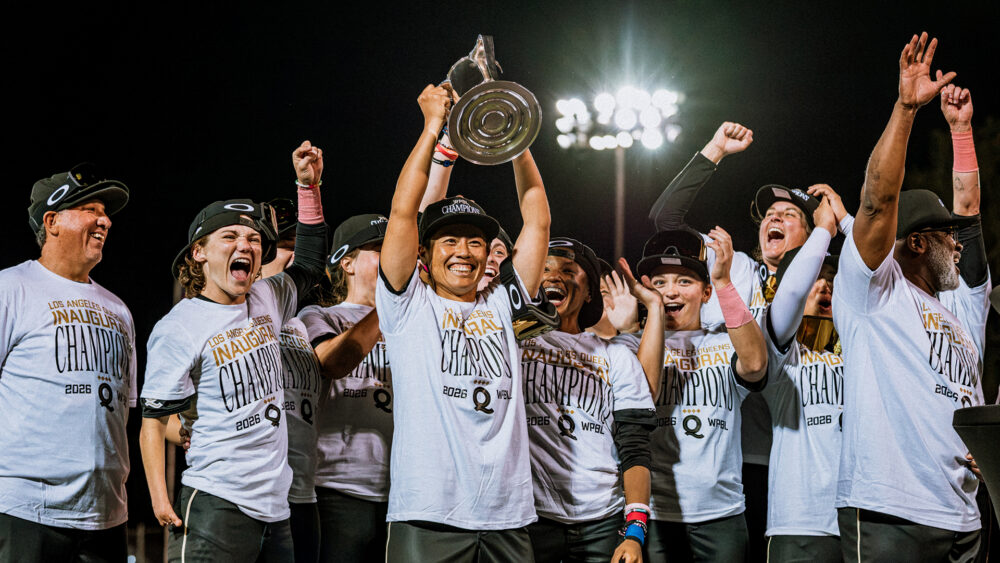
For generations, women who dreamed of playing professional baseball had to fight for a place on the field. On Tuesday, Sept. 22, the Los Angeles Queens gave that dream a new chapter, becoming the first champions of the Women’s Pro Baseball League in a 2-0 victory over the San Francisco Firebells.
The championship at Robin Roberts Stadium in Springfield, Illinois, marked the end of the league’s inaugural season and the return of a women’s professional baseball league in the United States for the first time since 1954.
For the Queens, the moment was about more than a trophy. It was the culmination of a season that began with the team making history as the winner of the league’s first game and ended with Los Angeles making history again.
Pitcher Ayami Sato delivered a performance worthy of the occasion, throwing the first complete-game shutout in WPBL history. Sato allowed five hits, recorded no walks and earned Championship Series MVP honors as the Queens secured the title.
“Honestly, if I had started this season thinking about winning the finals, MVP, or trying to make great plays for myself, I don’t think I would have received this award,” Sato said. “Instead, I focused on giving everything I had for my team and doing whatever I could to help us succeed.”
The Queens scored both of their runs in the third inning, turning a tightly contested pitching duel into the deciding advantage. Mo’ne Davis recorded both of Los Angeles’ hits, while captain Ashton Lansdell drove in a run on a fielder’s choice.
San Francisco had entered the championship series as the league’s regular-season leader, finishing 10-5. After dropping the first two games of the best-of-five series, the Firebells responded with back-to-back wins to force a decisive fifth game.
But Sato held San Francisco scoreless, securing the championship for a Queens team that had endured its own ups and downs throughout the season.
“We dared to trust the process,” Lansdell said. “We’ve been through all the ups and downs that a pro team can go through and we just stuck with each other. Trusted in each other and embraced every single moment.”
The Queens’ name carries a piece of baseball history of its own. The team is named in honor of Lizzie Murphy, nicknamed the “Queen of the Diamond,” who became the first woman to play against major league players. Her legacy connects the team to generations of women who challenged the boundaries of a sport that has long excluded them from its highest levels.
The WPBL’s inaugural season brought together four teams, the Queens, Firebells, New York Heights and Boston Hunters, in Springfield. More than 60 women competed in the league, giving players an opportunity to train and play professionally rather than having to fit baseball around other jobs or find opportunities on men’s teams.
The league also provided a platform for athletes who have spent years building the women’s game. Sato, a three-time Women’s Baseball World Cup MVP, has competed internationally and played professionally in Japan. Davis, known for her run to the Little League World Series as a teenager, continued her baseball career with Los Angeles. Their presence reflects the range of experience and paths that brought players to the new league.
For many of these athletes, the opportunity to play professionally is about more than their own careers. It is also about making that path visible to the girls watching from the stands and at home.
“This is for everyone who fought for us on and off the field, including the women of the All American Girls Professional Baseball League, and those women who played in the Negro Leagues,” WPBL Commissioner Justine Siegal said. “Our championship trophy is for our fans, for all the girls who dream big, and for the LA Queens.”
The Queens’ championship does not mark the end of that work. After decades without a women’s professional baseball league in the United States, Los Angeles leaves Springfield with the inaugural title, while the WPBL leaves its first season with a foundation to build on and a new generation of players who can see a professional future in the sport.
Photo courtesy of the Women’s Pro Baseball League
