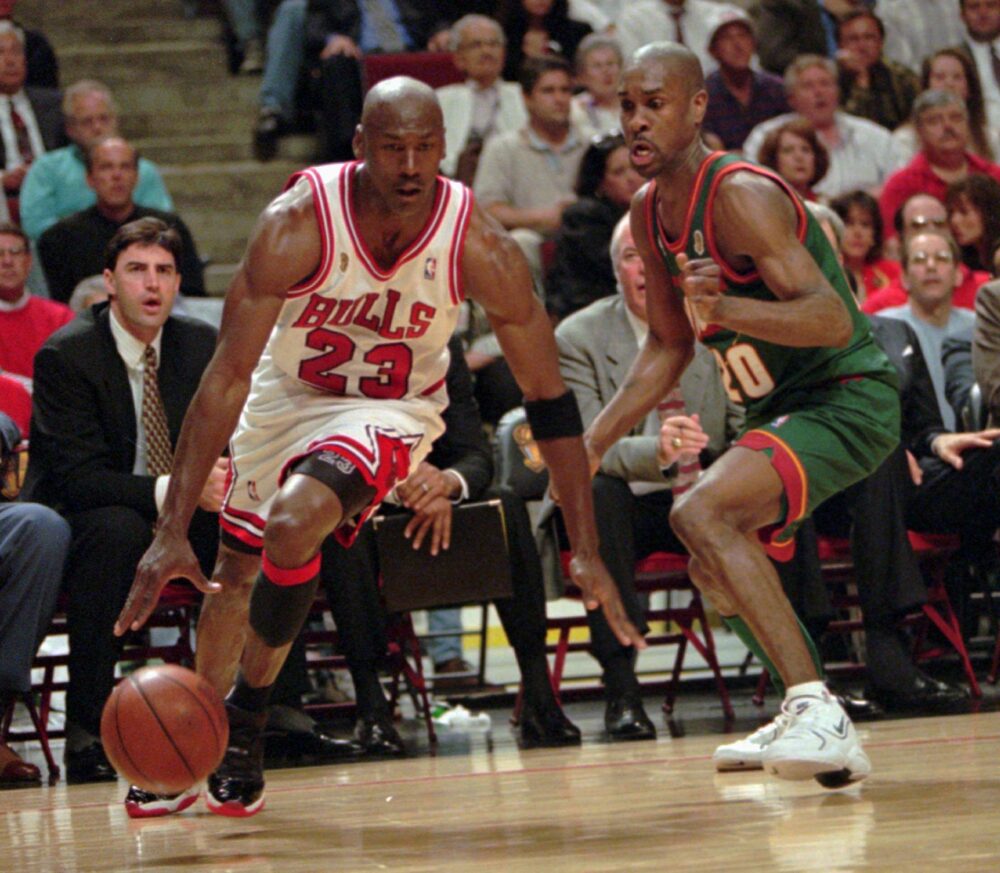
Michael Jordan’s conditioning wasn’t adequate when he made his surprising return to the NBA in 1995. Jordan still helped the Chicago Bulls have a 13-4 record in his first 17 games back. Then, the team entered the playoffs as the fifth seed in the Eastern Conference and eliminated the Hornets in four games in the first round.
In the second round, the Magic, led by Shaquille O’Neal, Anfernee Hardaway, and Horace Grant, were too much for the Bulls and they lost that series in six games.
Jordan was away from the league for 21 months and it showed against the young and talented Magic. The lack of conditioning caught up to Jordan and the Magic proved why they were favored to go far in the playoffs. Jordan’s trainer Tim Grover knew he would eventually feel the effects of coming back to the NBA without training for basketball for an extended period of time.
“The training for baseball is completely different than the training for basketball. The easiest way to give an example is when you play basketball there’s a certain amount of arc that goes on a basketball shot to maximize the space on the rim. When you throw a baseball from right field you can’t put an arc on the ball, it’s got to be from point A to point B as fast as you can, so you have to retrain the whole shoulder muscle what movement it’s going to do,” Grover told GQ Sports.
“So the exercises we did for basketball were not applicable for baseball. The way you swing when you lead with your hips, completely different in baseball when you’re swinging a bat than when you’re stepping into a basketball shot.”
Jordan’s road back
When Jordan retired in 1993, Grover, his sports enhancement specialist for over 15 years, predicted that the Bulls legend would eventually come back to the NBA. Grover even put together a workout to get Jordan ready just in case.
“During my off time between his retirement and when we started the baseball training I had already started to put a workout together inside to do my research and homework saying if he ever comes back what’s gonna happen from a physiological standpoint what will we have to do in order to get him back,” Grover said.
“When he came back and he started to play we had a discussion with him and I said Michael there’s not enough time to transition your body because he came back at the end of that season and I said there’s not enough time to transition your body from baseball to basketball for you to be playing at the optimal level that you were before I said there just isn’t enough time.”
Grover said that while skill development was ultimately up to Jordan, his commitment to training was immediate. After Orland eliminated Chicago in Game 6 of the 1995 NBA Eastern Conference Semifinals, Jordan told Grover he would see him the next day, and the training process began right away.
“Now from a skill standpoint that’s on you okay, but I’m just telling you from a performance standpoint there just there just isn’t. When that happened I don’t remember the day that they lost that game to Orlando I think it was a home game, we were the last ones in the arena, we’re getting ready to leave out and I said Michael I’ll see you he goes I’ll see you tomorrow so that training process started right away,” Grover said.
Jordan had a busy summer as he had to film Space Jam, but he was determined to be the best player in the NBA again and lead the Bulls to more championships.
Jordan knew he had to get his body ready, so he told Warner Bros. that he needed a place to work out and practice while filming Space Jam. Warner Bros. suggested putting hoops and painting lines on a parking lot near the Space Jam set, but Jordan and Grover asked for better facilities, which led to the studio building the famous ‘Jordan Dome.’
The state-of-the-art inflatable dome had a full basketball court, locker rooms with showers, a weight room, big screen TVs, a card table, and a putting green.
Jordan filmed Space Jam from Monday to Saturday from 7 am to 7 pm, with a two-hour break for mid-day exercises with Grover. He then played pickup games with Magic Johnson, Reggie Miller, Patrick Ewing, Dennis Rodman, Horace Grant, Juwan Howard, Eddie Jones, LaSalle Thompson, Jack Haley, Shawn Bradley, and the UCLA team that won the NCAA tournament in 1995, to name a few.
(1995) Pick up games at the ‘Jordan Dome’ where MJ played against Reggie Miller, Juwan Howard, Dennis Rodman and others.
Mike would film ‘Space Jam’ during the day and play these pick up games at night. 🎞
— Timeless Sports (@timelesssports_) May 11, 2020
Jordan gained eight pounds of muscle that summer. Then, he led the Bulls to a 72-10 record in the 1995-96 regular season and an NBA Championship. Jordan won the regular season, NBA All-Star game, and NBA Finals MVP awards in 1996, and Space Jam grossed over $250 million at the box office.
