
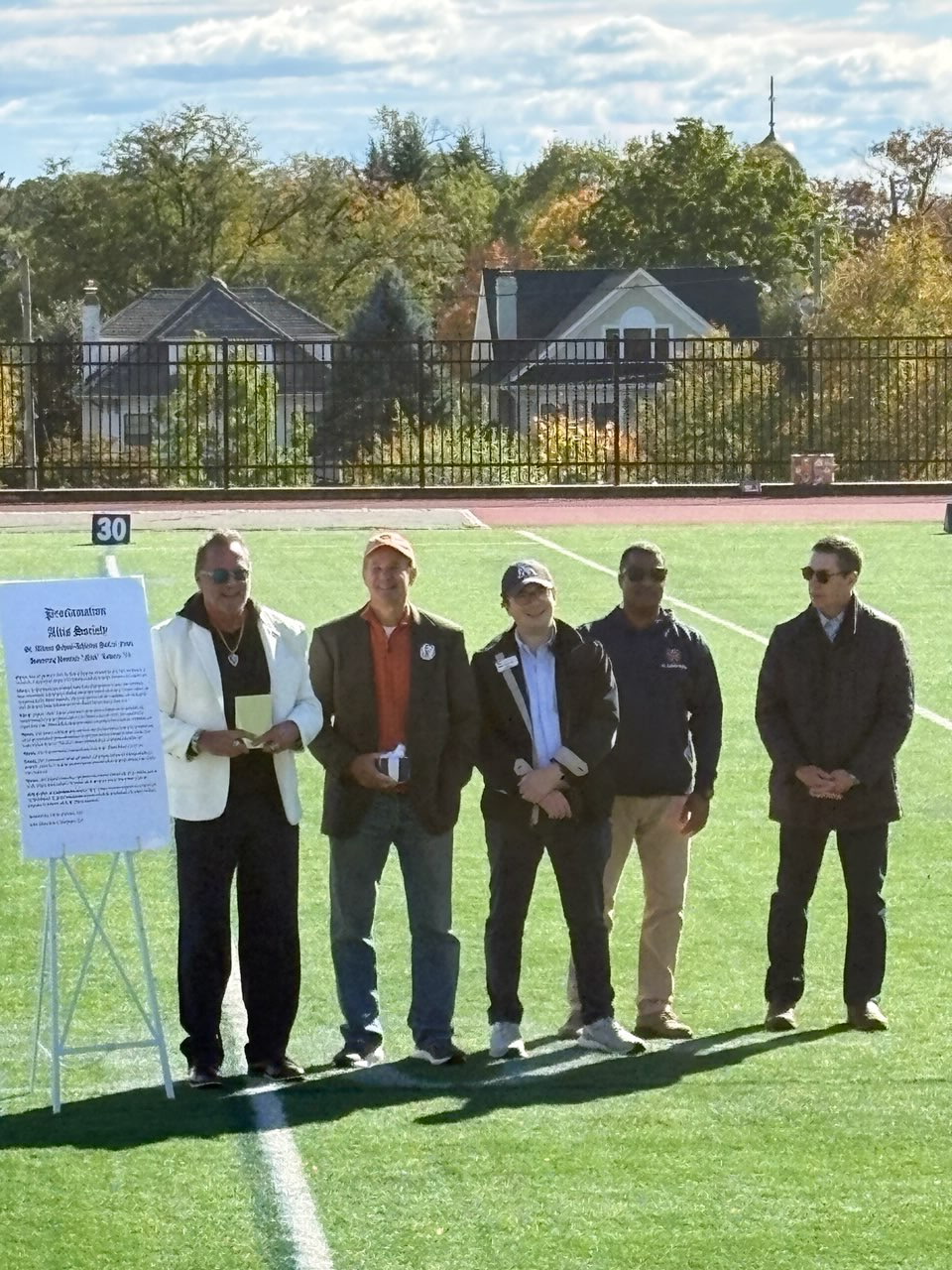
“Be grateful,” Nick Lowery said.
It was the advice he would give his younger self, the version of Lowery who first walked through the doors of St. Albans School in Washington, D.C., as a 10th grader and had no idea where football would eventually take him.
Decades later, Lowery returned to St. Albans for his induction into the school’s Athletics Hall of Fame, the Altis Society. Sitting beside his twin sister Anny, with longtime friend and former baseball teammate Rob Gordon, Lowery was surrounded by people who knew him long before he became an NFL kicker.
The homecoming celebration Oct. 17 honored what Lowery accomplished on the football field. But as he looked around at the people who helped shape his life, Lowery said the moment made him think about everything that came before the records, the NFL career and the honors.
“It makes you think about all the people, all the mentors, in the form of teachers, parents, friends, coaches, that taught you about all of the themes around resilience, about hanging in there, about doubling down, about digging deeper,” Lowery said.
Lowery said gratitude is not just about appreciating the people who helped him succeed. It is also about recognizing what he learned from the moments that did not go as planned.
“Stay grateful for all of the things it’s taught you, ’cause usually you learn more from the mistakes,” Lowery said.
At St. Albans, Lowery learned some of those lessons through football.
Lowery attended St. Albans his 10th grade year after attending the Potomac School in McLean, Virginia. By then, he had already played football, soccer and baseball and kicked his first field goal.
At St. Albans, Lowery’s kicking career took shape. His final high school kick came against Landon, the school’s longtime rival and became the one he remembered most.
With St. Albans trailing 7-6 in the rain and mud, Lowery kicked a 43-yard field goal as time expired to give his team the victory.
“The very last second of my high school career, where we beat Landon,” Lowery said. “That stands as kind of a legendary kick.”
Years later, after a professional football career that included stops with the New England Patriots, Kansas City Chiefs and New York Jets, Lowery said people often ask him about the biggest kick of his NFL career.
His answer is not an NFL kick.
“Actually, the biggest kick of my career was the kick against Landon,” Lowery said. “It was a powerful sign that I had potential to do great things.”
That potential eventually carried Lowery to a 19-year NFL career. He spent 14 seasons with the Kansas City Chiefs from 1980 to 1993 and became the franchise’s all-time leading scorer with 1,466 points. He was a three-time Pro Bowl selection and seven-time All-Pro.
Lowery was inducted into the Chiefs Hall of Honor in 2009. When he retired, he held NFL records for field goals made and was among the league’s most accurate kickers.
But football became only one part of Lowery’s life.
He attended Dartmouth College and later earned a master’s degree in public administration from Harvard Kennedy School of Government. He also became involved in service and advocacy work, including Native Vision, a program he helped start with Johns Hopkins and the NFL Players Association, and Champions for the Homeless, a program he said has worked for 20 years to put a human face on homelessness.
Those efforts reflect another lesson Lowery said he learned at St. Albans: privilege should create an obligation to give back.
“We’re raised privileged,” Lowery said. “And that word, entitlement and privilege, can be a two-edged sword. You can go, ‘Oh, I’m privileged. Well, wow, what a pejorative word. What a negative thing.’ No, privilege gives you an opportunity to do more things. So do something with it, darn it.”
Lowery credited a long list of teachers, coaches and mentors with helping shape that perspective. He remembered Canon Charles Martin, the headmaster during his time at St. Albans, for his leadership; Spanish teacher Juan Mejia, who died of cancer about 10 years after Lowery graduated; and grammar teacher Ferdinand Ruger, who taught him lessons about writing that Lowery believes are too often overlooked today. He also credited coaches Gary Gardner and Dick Johnson.
Johnson, a former stockbroker who Lowery said called himself a “clam digger from Maine,” became particularly influential in Lowery’s development as a kicker. Lowery recognized that the position required more than learning how to strike a football.
“The job of the kicker is equal parts mental and physical,” Lowery said.
Johnson helped Lowery understand the mental side of kicking, managing himself, his confidence and the internal dialogue that comes with performing under pressure. That lesson stayed with Lowery as he was rejected by eight NFL teams 11 times before establishing himself in the league.
The lessons Lowery learned at St. Albans eventually followed him far beyond the football field. The school taught him about hard work, responsibility, service and caring for others, lessons he carried into his career, education and work with young people.
That is what made the Altis Society honor meaningful to Lowery. The Hall of Fame represented more than what someone accomplished as an athlete. It recognized the character a person builds and what they choose to do with the opportunities they are given.
Lowery has tried to live out that philosophy throughout his life. The goal was never simply to discover what he was good at, but to develop that ability and use it to help others.
“The journey first is to discover them, to nurture them, to turn them into a craft, and then to give that to others as well,” Lowery said.
That philosophy has shaped the legacy Lowery hopes to leave behind. When he returned to St. Albans, he was not simply returning to the place where his football career began. He was returning to the people and lessons that helped shape the person he became.
