
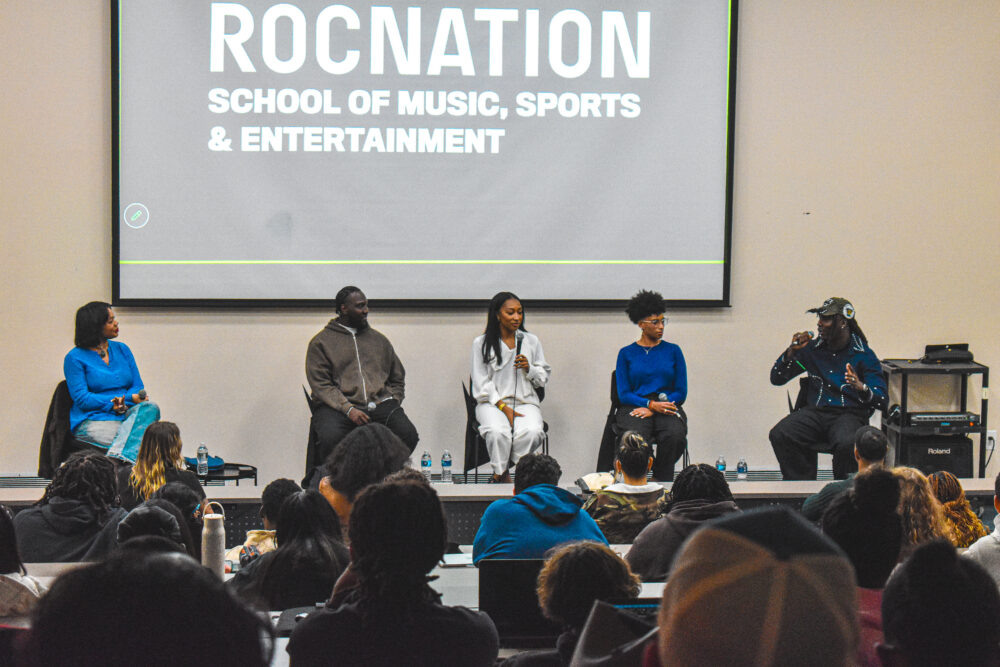
Students pursuing careers in sports, fashion and entertainment can learn the skills they need in a classroom, but building industry relationships and gaining professional experience can help them understand how those skills translate into a career.
That was the goal of the Sports Meets Fashion panel hosted Oct. 7 at Long Island University’s Roc Nation School of Music, Sports & Entertainment. The discussion brought students, faculty, industry professionals and members of the public together to explore how sports, fashion, media and entertainment intersect as well as how those connections can create opportunities across industries.
Arias Limuel, an adjunct professor at the Roc Nation School of Music, Sports & Entertainment and a brand media executive, organized and moderated the panel. With previous experience in production and public relations at ESPN and teaching media at the Fashion Institute of Design and Merchandising, Limuel brings both industry experience and classroom instruction to her work.
Limuel invited professionals already working across sports, fashion and entertainment to give students, faculty and other attendees an opportunity to learn from people navigating those industries firsthand.
“I strategically sent the RSVP to people who worked in the space already so that people who went to our school could actually be sitting next to people who work in the space,” Limuel said.
The panel featured Brauna Marks, a sports broadcaster and creative producer whose experience includes work with the NBA, Spectrum News and GQ Sports.
The panel also included Moses Anoh, an athlete marketing and brand partnerships professional who previously worked with the NFL Players Association, discussed building Blitz Media Group and connecting sports, fashion and culture.
Robyn Mowatt, another featured panelist is a senior editor, independent journalist and cultural consultant based in Brooklyn, has written about fashion, music and culture for publications including Vogue, ELLE, Harper’s Bazaar, Rolling Stone, NPR and ESSENCE.
The final panelist was Zay Fofana, also known as Moses “Zay” Fofana, a New York-born stylist, creative consultant and model with West African roots. His styling work spans music and sports, with collaborations involving artists such as Kanye West, J. Cole, A$AP Rocky, Lil Durk and Nas.
Their varied backgrounds gave attendees a look at the ways professionals can build careers across sports, fashion, media and entertainment rather than remain within one industry.
Limuel said she wanted the discussion to reach people at different stages of their professional journeys, including current students, prospective students, faculty and people already established in their fields.
“So the cool thing about the engagement was everyone got a dose of what they were looking for, but they also got a dose of what they weren’t expecting that could still benefit them,” Limuel said.
The conversation also centered on cultural storytelling, the shared thread connecting the industries represented on the panel. Limuel wanted students to recognize that their interests and skills could translate into fields they might not have initially considered.
“If you are in a creative work pathway, where you want to work in the creative field, you have to understand what culture means,” Limuel said. “If you know what culture means, you can thrive in music without having a music background. If you know what culture means, you can thrive in sports without having a sports background.”
For Limuel, that message reflects the kind of preparation students need as they explore careers in creative industries. She said students want educational experiences that introduce them to professional environments before they graduate.
“They are looking for a program that already puts them in the spaces that people don’t usually get to until after they graduate,” Limuel said.
The panel also created an opportunity for the school to build relationships with potential partners and members of the broader professional community. Limuel said those connections can help expand resources for students and introduce more people to the school’s academic programs.
That emphasis on industry access is also reflected in Limuel’s teaching.
Alongside her role at LIU, Limuel works full time as a vice president of brand and communications for a sports agency. She uses her professional experience to develop case studies that allow students to work through real-world campaigns and creative strategies.
Limuel brings that same industry experience into her classroom, giving students opportunities to work on the kinds of campaigns she develops professionally. While working on fashion campaigns outside the university, she built similar projects into her coursework, allowing students to explore the strategies behind campaigns connected to GQ Sports and Men’s Health magazine.
“For example in my content class, I was teaching them how to work on fashion campaigns,” Limuel said.
The connection went beyond classroom exercises. As Limuel worked on similar campaigns professionally, she incorporated her students’ ideas and strategies into her work, giving them an opportunity to contribute to projects beyond the classroom.
“So their ideas, their thoughts, their strategies, I got to integrate into my work,” Limuel said.
Limuel said she also credits students for their contributions, connecting their classroom work to the professional projects they helped inform.
Limuel’s teaching extends beyond campaign development to the professional skills students need to succeed in those environments. Limuel emphasized the importance of learning how to communicate, network, present oneself and build a professional identity.
One example is a brand portfolio assignment developed by fellow professor Tajay Ashmeade, which Limuel said helps students learn to present their work and establish their professional identities while still in school.
Those skills can become particularly important in industries where opportunities may depend on both the quality of a person’s work and the relationships they build.
Limuel also pointed to industry partnerships as a way to provide students with access to resources and experiences they might not otherwise have. She said the school’s connections can help students attend events, access facilities and build relationships with professionals and organizations.
“We have access to games, events and visiting these different industry giants where we don’t have to make an appointment. We can just make a phone call,” Limuel said.
The Roc Nation School launched at LIU in 2021 through a partnership with Roc Nation. Its academic programs connect students with music, sports and entertainment, while its industry-focused approach emphasizes preparing students for careers that can cross traditional professional boundaries.
For Limuel, the goal is to help students recognize how their interests and skills can transfer between industries while giving them opportunities to practice those skills before entering the job market.
As sports, fashion and entertainment continue to influence one another, the panel offered students and industry professionals a space to exchange perspectives, build connections and consider new career possibilities. For students, those conversations can help make professional pathways more visible; for educators, they can reinforce the importance of connecting classroom learning with the industries students hope to enter.
This article is in partnership and collaboration with Listen In With KNN.
Photo courtesy of Jacin Brown, LIU fashion student.
