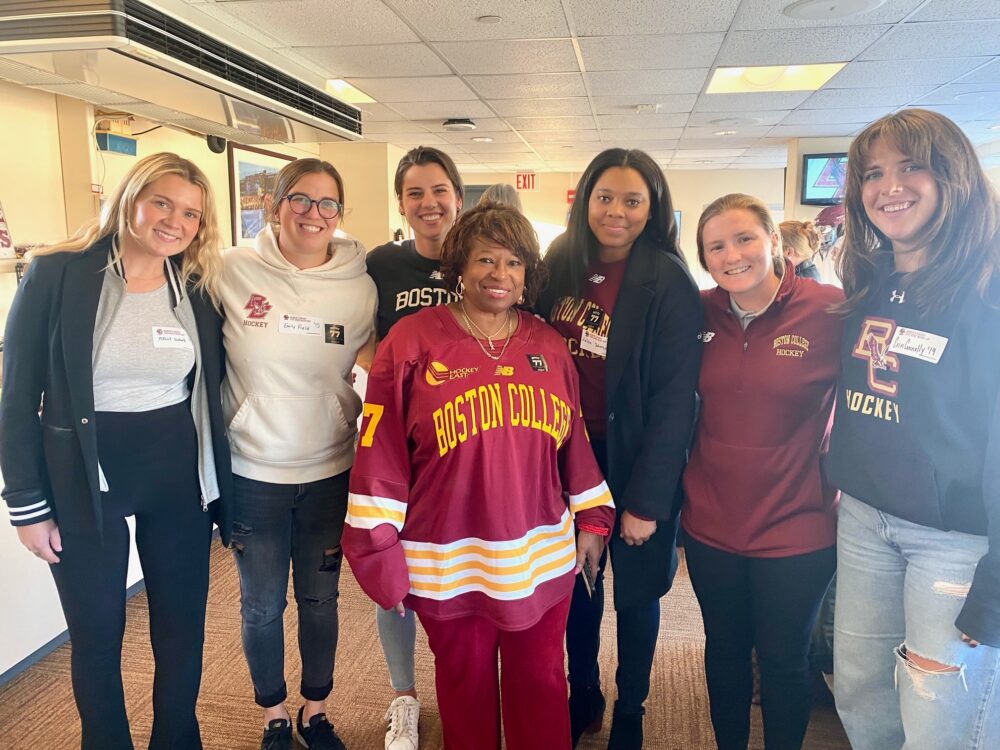
Doxie McCoy never expected to make history when she arrived at Boston College in 1973. With an older sister already enrolled at Brown University, the fifth-generation Washingtonian wanted to continue her education and play field hockey, while pursuing her interest in writing.
While she was still in high school, Title IX was passed in 1972. A year later, the D.C. native arrived at Boston College in 1973 and became one of the original members of the school’s women’s ice hockey team, which began as a student-run club.
McCoy grew up in Washington D.C., with three sisters in a family that emphasized the importance of hard work and pursuing their goals. Her parents encouraged their daughters to pursue opportunities, no matter how unconventional they might seem.
That mindset followed McCoy to Boston College, where she majored in communications and English because she wanted to become a writer. She also played field hockey as a goalie, a position she had taken up in high school, following in the footsteps of her older sister who was a star player on the team.
Her experience as a goalie eventually led to an unexpected opportunity.
While McCoy was wearing her field hockey pads, Boston College hockey coach John “Snooks” Kelley approached her about joining the school’s new women’s ice hockey team. Kelley, a U.S. Hockey Hall of Famer, had coached the Boston College men’s hockey team for several decades.
There was one issue:
“I did not know how to skate,” McCoy said.
Kelley told her that she would have a coach to teach her and explained that goalies did not have to skate as much as the other players. McCoy decided to give it a try.
“I thought, ‘Why not? I’ll try it,’” she said.
The team brought together students with different athletic backgrounds. Some players had experience playing ice hockey or figure skating, while others came from different sports. McCoy’s field hockey experience translated quite impressively onto the ice.
At the time, the Boston College team operated as a club and did not receive the same university support or funding as some of the more established women’s hockey programs in New England.
One of McCoy’s strongest memories came during a game against Vermont. Boston College faced a team with considerably more hockey experience, and McCoy spent much of the game stopping shots. Although Boston College lost by a large margin, McCoy said she was proud of her performance in goal.
“Even though we lost and the score was big, I actually did pretty well because I stopped a lot of pucks from going into the net,” McCoy said.
The team McCoy helped start eventually developed into Boston College’s NCAA Division I women’s hockey program. Since its launch in 1994, the program has since made multiple NCAA tournament appearances and produced U.S. Olympians.
McCoy did not initially see herself as a trailblazer. Years later, however, an article in the Boston College alumni magazine highlighted her role on the inaugural team. The article also suggested that McCoy may have been the first Black female athlete at Boston College, following the school’s transition to coeducation. McCoy said she was surprised by the recognition.
“I really didn’t view myself as any kind of trailblazer or any kind of history maker,” she said.
Her experience as an athlete also reinforced lessons she learned from her parents. McCoy said sports taught her discipline and fellowship, important values she continues to apply in her life and community work.
Today, McCoy remains active around the D.C. community through Alpha Kappa Alpha Sorority, Inc. Her chapter has participated in programs that mentor middle school students and support local schools. Through its Youth Leadership Institute, McCoy has helped teach students about academics, life skills and professional etiquette.
For McCoy, her experience on the ice at Boston College was not initially about making history. It was about seizing an opportunity and walking to the beat of her own drum — values that were instilled by her parents, derived from her origins in Washington, D.C.
This article is in partnership with Listen In With KNN.

Senior at the Philip Merrill College of Journalism
UMD '27