
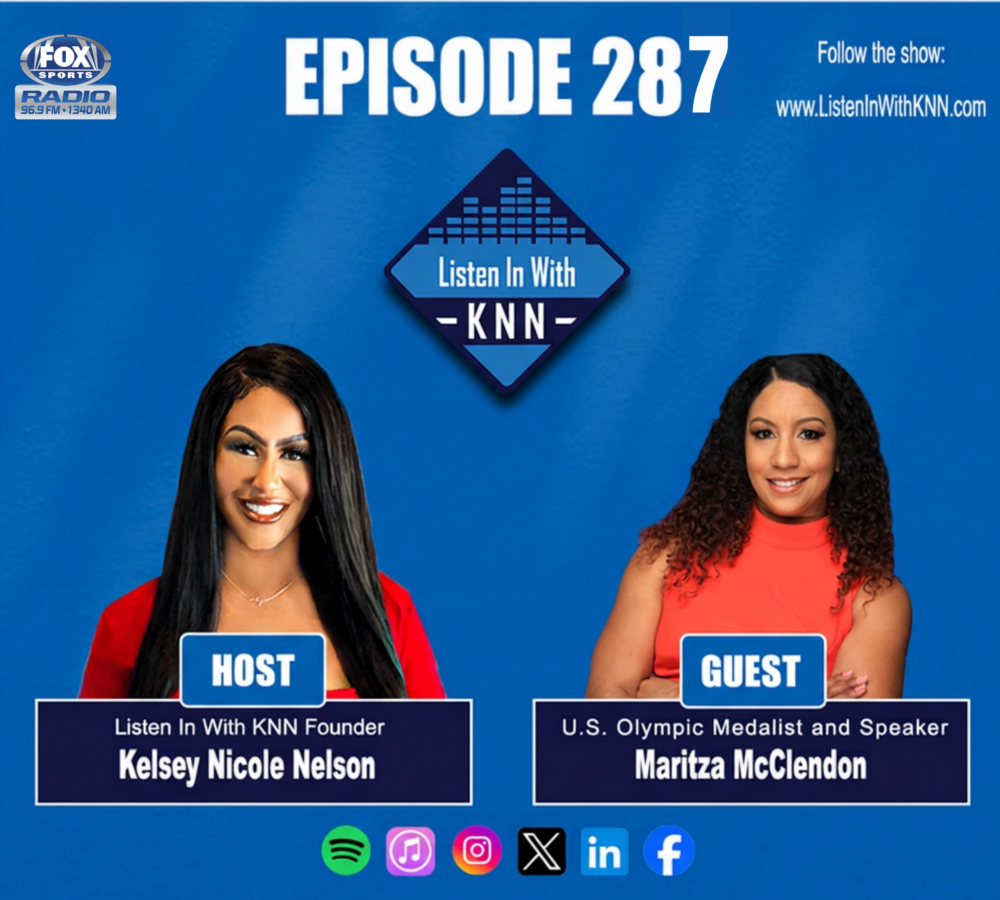
Olympic silver medalist Maritza McClendon joined our host and reporter, Kelsey Nicole Nelson, on the latest episode of “Listen In With KNN” sports and entertainment podcast, to reflect on her decorated swimming career, the pressure of breaking racial barriers and her ongoing mission to make swimming more accessible to underserved communities.
McClendon, formerly Maritza Correia, made history at the 2004 Athens Olympics as the first Black woman to represent the United States in Olympic swimming and earn an Olympic swimming medal.
“When I made the Olympic team, I was the first Black woman to make a U.S. Olympic swim team, and also medal,” McClendon said, talking recently to Nelson. “To have that barrier broken (in 2004), that really wasn’t that long ago, right?”
However, her journey to the Olympic podium began under unexpected circumstances.
Born in San Juan, Puerto Rico, to Guyanese parents, McClendon was diagnosed with scoliosis at age seven. When doctors suggested surgery, her mother looked for alternatives, with one doctor recommending swimming, which McClendon joyfully accepted, already possessing a love for the water.
What began as a medical recommendation quickly developed into a passion. After her short water safety program concluded, she told her mother of her desire to swim every day, leading to McClendon joining a swim team.
After moving to Tampa, Florida at the age of nine, McClendon joined a competitive swim team under the guidance of now American Swim Coaches Association Hall of Fame coach Peter Banks.
Banks, who went on to be the USA’s Assistant Women’s Coach for the Sydney Olympic Games, recognized McClendon’s potential, telling her she could become one of the world’s best swimmers if she remained focused and committed to training.
“I remember that’s when my Olympic dream kind of sparked,” McClendon recalled. “I was like, okay, I can absolutely do this.”
She later earned a full scholarship to the University of Georgia, where she became an 11-time NCAA champion and 27-time All-American.
However, as her career progressed, McClendon faced mounting pressure, not only as one of the few Black athletes competing at elite swimming events but also from her family and the media, who anticipated she would become the first Black woman to make the U.S. Olympic swimming team.
This pressure culminated in her failure to make the 2000 US Olympic swimming team, forcing McClendon to re-evaluate her motivations and completely shift her mindset.
“It’s not to please the media, and it’s not to please my dad,” McClendon said. “But it’s really like, what is my inner purpose for doing this.”
Her renewed focus paid off in 2004 when she qualified for the Athens Olympics, eventually earning a silver medal as a member of the women’s 4×100-meter freestyle relay team.
“I remember touching the wall and seeing my name and seeing that I had made the Olympic team,” she recalled, going on to describe the euphoria of running across the pool deck to embrace her coach afterward.
After all the setbacks, Athens was the crescendo of years of hard work and fighting for herself. “Just the pride of that moment was surreal,” McClendon said.
More than two decades later, McClendon has transformed her achievements into a platform advocating for water safety and greater diversity in aquatics. She told Nelson that despite improvements in swimming participation, significant racial disparities remain. According to figures she cited during the interview, 64% of Black children and 40% of Hispanic children do not know how to swim.
McClendon attributed these disparities to several factors, including the generational effects of segregation, limited access to swimming facilities, financial barriers and concerns surrounding hair care.
As a board member of Diversity in Aquatics, McClendon helps promote water safety education and expand opportunities for disadvantaged communities to participate in aquatic activities.
McClendon is also involved in Swim 1922, a partnership between Sigma Gamma Rho Sorority Inc. and the USA Swimming Foundation that provides swimming lessons and water safety education. Since launching in 2012, the initiative has reached hundreds of thousands of participants and expanded internationally, including a recent event for 50 children at Ramstein Air Base in Germany.
As she continues her advocacy, she remains focused on making swimming more accessible and sharing her passion with future generations.
“I’m definitely working on continuing to break barriers,” she said, “and bring joy to the sport that brought me so much joy to others.”
McClendon continues to encourage families to explore local swimming programs and recommends visiting USA Swimming’s website to locate nearby pools and beginner programs.
To learn more about McClendon’s advocacy and upcoming events, visit her website at martizamcclendon.com or follow her on social media @ritzyswims.