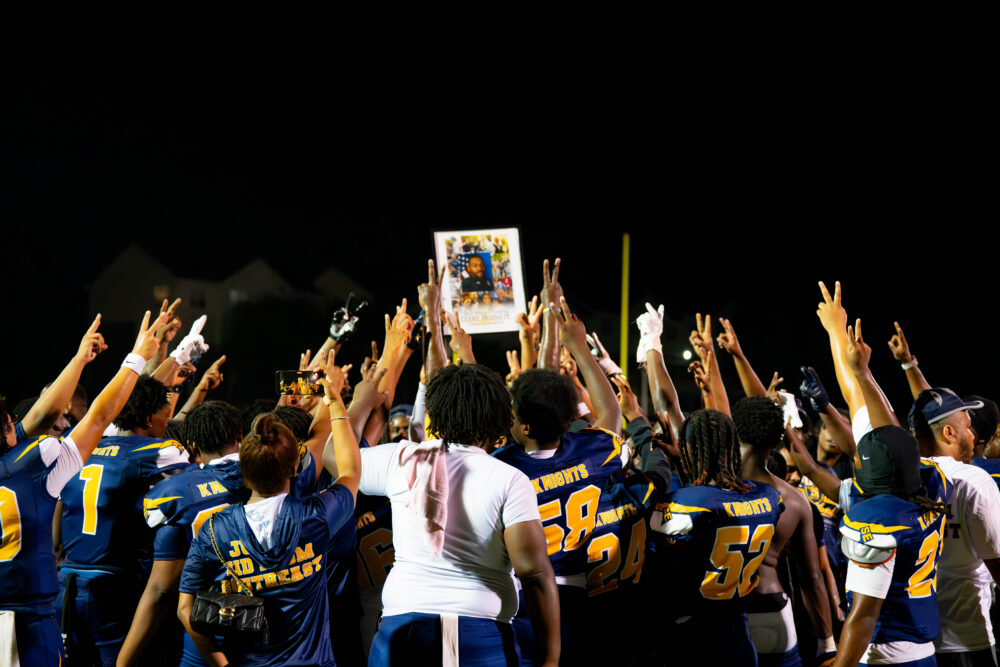
For a community still carrying the loss of one of its own, Ballou High School’s season opener became a night of remembrance, resilience and redemption.
Terry Bennett was more than a football coach. He was a Ballou alumnus, a former Knights coach and a Metropolitan Police Department officer who spent more than a decade mentoring young people at the school. Born and raised in Washington, D.C., Bennett served as Ballou’s assistant head football coach and defensive coordinator, earning recognition from his peers and the community for the impact he had on students.
In December 2025, Bennett was struck by a vehicle while assisting a stranded motorist on Interstate 695 near South Capitol Street in Washington. He died from his injuries Jan. 7, 2026, at age 32. A nearly eight-year veteran of the Metropolitan Police Department, Bennett was a Ballou alumnus who returned to serve the school as an associate dean, assistant head football coach and defensive coordinator. Beyond the field, he spent more than a decade mentoring young people and was known for helping build connections between law enforcement and the community.
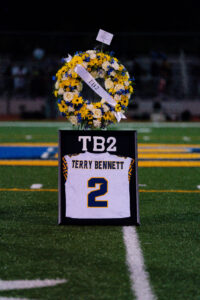
So when Ballou and Ron Brown High School were set to meet on Friday, Aug. 28, the game was about more than opening a football season. It was supposed to be “TB2 Night,” a tribute to Bennett, who wore No. 2 and whose presence remained deeply woven into the program.
But for a time, it was unclear whether the night would happen at all.
The proposed matchup initially was not approved by the District of Columbia Interscholastic Athletic Association. Both teams had lost previous game commitments for Aug. 28 and sought to play each other after the scheduling deadline.
In email correspondence with Ballou parent Matthew Borie, DC Public Schools officials said the game was not included in the approved schedule and had not received the necessary DCPS and DCIAA authorization. Officials also noted that athletic contests must satisfy operational, staffing and student safety requirements before they can be approved.
That uncertainty sparked a community effort to keep the game alive.
In a series of emails to DCPS officials, Borie said he secured more than $15,000 in private donation pledges and identified The St. James athletic complex in Virginia as an alternative venue for the matchup. He asked DCPS and the District of Columbia Interscholastic Athletic Association to approve the contest and provide transportation for both teams.
Yet on Aug. 21, district officials said the game had not completed the required approval process and would not move forward.
The Chief of the Office of Social-Emotional and Academic Development Strategy for District of Columbia Public Schools disclosed the proposed game, including the plan to play at The St. James, had not been approved.
Neither the fundraising, venue arrangements and outside support organized around the game had been authorized by District of Columbia Public Schools or the District of Columbia Interscholastic Athletic Association.
However, officials acknowledged Bennett’s contributions to the Ballou community and said his legacy remained important and deserving of recognition.
The uncertainty was disappointing for the D.C. community who believed the matchup could bring the families of Ballou football together while honoring a coach, alumnus and police officer who had spent years investing in the program.
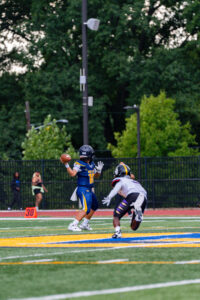
Above all, the night they had fought so hard to create finally happened.
And once it did, Ballou gave the night a meaning of its own.
It started with senior quarterback Max Stovall finding sophomore Shamar Jackson for a one-handed touchdown that gave the Knights an early lead.
Ron Brown quickly responded, and with roughly two minutes remaining before halftime, the Monarchs intercepted a Ballou pass and returned it for a touchdown.
The Knights went into halftime down 26-6.
Something changed in Ballou’s locker room at halftime. The Knights came back onto the field with a renewed sense of urgency, steadily erasing Ron Brown’s lead before completing the comeback in the final minutes.
But before the final chapter was written, Ballou paused to remember why the night mattered in the first place.
The halftime ceremony honoring Bennett brought together members of the Ballou community and D.C. police officers who knew and worked alongside him.
According to Nick Soughley, a community member who attended the game, the chief of the Metropolitan Police Department and other officers who knew Bennett were also in attendance.
For Soughley, the comeback represented more than a football victory.

“It was an incredible game and, as an outsider, it was truly amazing to see the resiliency of those young men led by Coach Kenny,” Soughley said.
The Knights completed the comeback in the final two minutes, with the winning touchdown coming from the player wearing Bennett’s No. 2 jersey.
Ballou won, 28-26.
The symbolism was difficult to miss. On a night created to honor Bennett’s legacy, the player wearing his number delivered the score that gave the Knights the win.
“There are a lot of stereotypes about SE DC, but the entire coaching staff, administration and supporters, these young men are being prepared for life,” Soughley said. “Of course it was amazing to see them win; the coaching staff genuinely wants to see these young men succeed in life.”
That message was especially significant for a program that had spent the offseason preparing its players through winter workouts, spring football, 7-on-7 tournaments, summer employment programming and fall camp while grieving Bennett’s loss.
Matthew Borie, whose son Max is Ballou’s quarterback, described the role football plays in the lives of the Knights.
“Football is helping change the lives of these Ballou student-athletes and my opinion is that every game counts,” Borie said.
For a community that had spent the days leading up to the season opener fighting to preserve the opportunity to play, the final result meant more than an opening-night win.
It was the night Ballou fought to have, the night the community fought to preserve and ultimately, the night the Knights gave back to the man they came together to remember.
“It was a night I will never forget,” Soughley said. This story is in partnership with Listen In With KNN.
