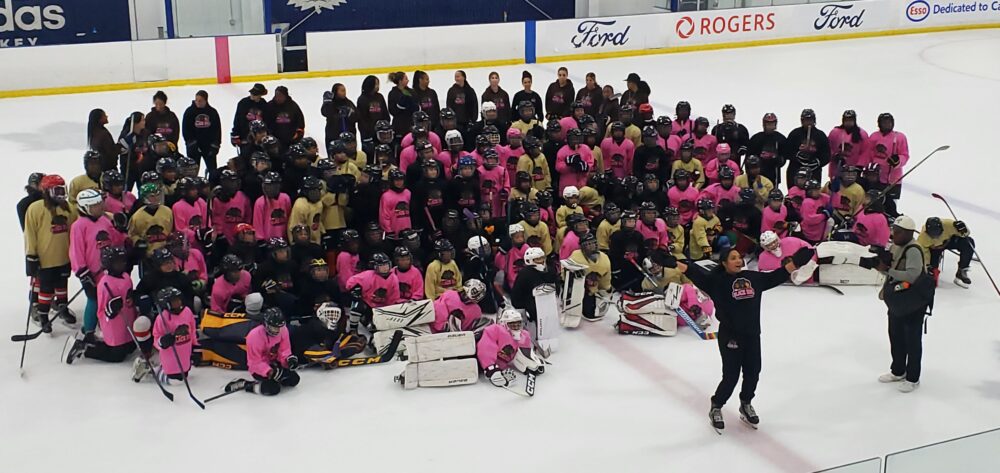
After scoring all three goals in a 3-1 championship upset, 14-year-old Alix Kennerly has spent the week in Toronto at the Black Girls Hockey Camp and Summit — part of a growing push to spotlight Black girls’ hockey from the DMV to the international stage.
Girls’ hockey participation still trails boys’ across the U.S., and Black girls face even steeper odds breaking into the sport.
But players like Kennerly are helping change that narrative while bringing fresh attention to a game that is only beginning to diversify.
The camp, which began July 11, gathers hundreds of Black girls from across North America for a weekend of elite training, mentorship and community-building.
Participants rotate through daily on-ice sessions, off-ice workshops and leadership activities led by some of the sport’s most accomplished Black women.
Organizers also offer financial aid to help offset travel, lodging and equipment costs, a barrier that often keeps many families from participating.
Kennerly, who started skating at age four with the Fort Dupont Kids on Ice program in Washington, D.C., has played on teams where many of her teammates were years older — sometimes well into their 20s.
After standout seasons with the Northern Virginia Ice Dogs and DC Titans, she recently earned a spot with the Montgomery Youth Hockey Association’s Girls 19U AA Ice Devils, the only team of its level in the region.
This summer, she was invited to join Hockey Core, the Ice Devils’ developmental program, and will also play for the Puerto Rico National Women’s D2 Team at the LATAM Cup.

“I’m excited to go to Toronto, especially after how much fun I had last year just being with people,” Kennerly said. “Everyone was super welcoming and comfortable.”
Last year, the camp drew only three U.S. participants — all from the DMV. This summer, organizers expect that number to double.
While hockey remains one of the nation’s least diverse sports, the region has seen a slow uptick in participation among Black girls.

“What I’m seeing with black girls in the game is there is an uptick in the number of girls participating, but also there’s a corresponding increase in the number of girls that are reaching some of the most competitive and highest levels of place as well,” said Alix’s father, Iman Tariq Kennerly, who also coaches youth hockey.
The camp’s coaching staff includes Saroya Tinker, a former professional defender and the camp’s executive director; Sophie Jaques, a Patty Kazmaier Award winner and back-to-back Walter Cup champion; Mikyla Grant-Mentis, a former PHF MVP; and Christine Chao, a former pro and advocate for underrepresented players internationally.
“For me, it was really different playing with all girls, but it was really fun, especially having the female coaches,” Kennerly said.
Kennerly’s success has come with challenges, including steep costs for equipment, tournament fees and travel that multiply as players advance.
Her father says the financial barriers can be especially hard for families without support networks or coaching connections.
“As Alix plays at more competitive levels, there are more tournament fees and travel costs,” Iman Traiq Kennerly said. “Just the basic fees, you’re talking triple or quadruple the amount of money.”
Despite the obstacles, Kennerly is focused on her future. She hopes to play nationally and eventually compete in college, a goal made more visible as professional women’s leagues gain traction and expand opportunities for the next generation.

“It’s really great there are opportunities for girls to play hockey,” Kennerly said. “I would tell other girls it’s the most fun sport and to enjoy it as much as you can.”
For her and hundreds of others gathered in Toronto, the camp represents more than training — it’s a vision of what the sport can look like when everyone has a place on the ice.
