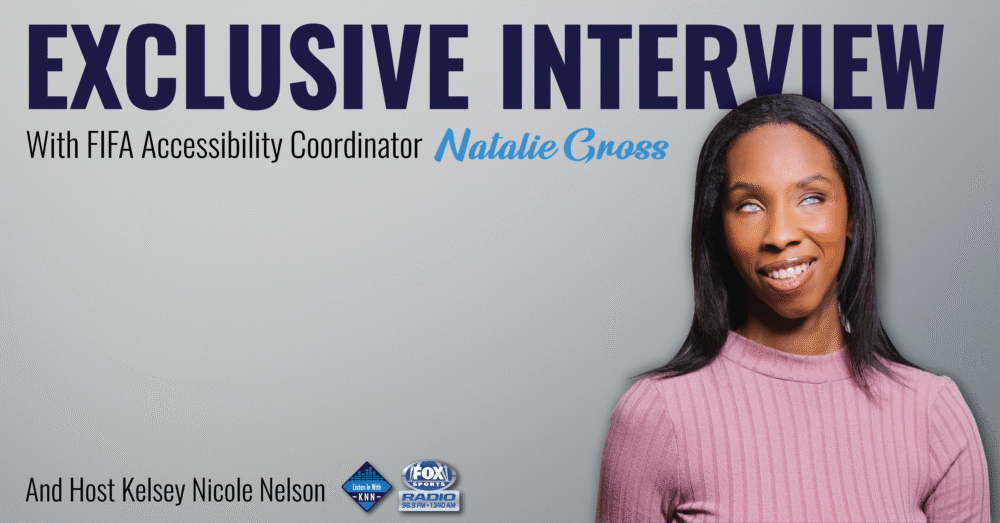
On the latest episode of “Listen In With KNN” , award-winning host and executive producer Kelsey Nicole Nelson had the opportunity to sit down with FIFA Accessibility Coordinator Natalie Gross, to discuss preparation for the FIFA World Cup 2026 and lessons learned from FIFA Club World Cup.
Gross opened by sharing FIFA’s mission is to ensure every fan feels seen, heard, and included, regardless of ability.
From her inspiring personal journey of overcoming adversity, sharing her own of being empowered in her role from her disabilities she has worked as part of FIFA to help continuously evolve the game for deaf and blind fans. From the groundbreaking new technology FIFA is using for games Gross is a driving force behind one of the most inclusive sporting events in history.
Host Nelson set the tone early, praising FIFA for their efforts of making all their games inclusive.. As FIFA’s accessibility coordinator, Gross ensures that fans have a seamless and inclusive game day experience from the moment they go online to buy tickets, to how they hear and view the game Prior to her current role, Gross worked as the sustainability and human rights venue manager of the 2025 FIFA Club World Cup at the hosting site, Atlanta’s Mercedes-Benz Stadium. Her career has also included work as an accessibility consultant for Lavant Consulting Inc, a disability inclusion firm. With earlier roots in theater, acting, and dance.
Her passion for accessibility was born from personal experience.
“I thought I was actually going to be a sports publicist … but nobody was hiring a blind publicist at that time. It was very not inclusive… That’s kind of how I got into my disability inclusion work.”
When she saw the job posting for FIFA’s accessibility coordinator during her time working with Lavant Consulting , Gross saw the opportunity as a combination of both of her interests between working on creating inclusion while diving deep into her passion for sports. As Gross said in response to finding the job advertisement, “I feel like this is meant for me.”
One of the innovations Gross has championed is Audio Descriptive Commentary (ADC), first introduced at the 2014 FIFA World Cup in Brazil and used at the Qatar 2022 and Women’s World Cup 2023 tournaments.
Through the FIFA ADC app, fans can hear detailed play-by-play descriptions of what’s happening on the pitch.
“Some feedback I got from friends was like, ‘I never considered myself a soccer fan, but when you told me that there was audio description app,’ you know, audio descriptive commentary, ‘and I could go and follow along, I feel like, now I want to keep up with it.’ They were like, ‘maybe I’ll find me a team, and I can keep watching it.’ And so I think that’s what makes this work so exciting.”
The real-world impact of the tool is powerful as Gross emphasized that making sports more accessible doesn’t just serve existing fans — it creates new ones.
“It’s not that we’re just making experiences accessible for fans. We’re also creating new fans … for folks that may not have had an interest in sports because it wasn’t accessible.”
To support the rollout of ADC, FIFA has been proactive in training the next generation of inclusive broadcasters. Ahead of the Club World Cup 2025, aspiring commentators were trained to describe all the visual elements of a match — everything from player movement to emotional reactions — to ensure a fully immersive experience for blind and low-vision fans.
Technological tools like OneCourt’s haptic boards are also being used to enhance accessibility. These raised boards allow fans to feel the game through vibrations that correspond with the ball’s movement.
“They were like, it was just such a fully immersive match … the best live sports experience that I’ve ever had,” Gross recalled.
Feedback is essential to Gross’s approach. As she asked for endless reviews from the blind and deaf communities to further improve the ability of the app. Making sure that fan’s opinions were always a top priority.
“I was intentional about greeting fans… and checking in with them when they left,” she said. “ It’s the same thing for our ASL commentary, like we were able to send out a survey and get feedback directly from Deaf fans on how they thought that commentary went for them as well, because we also had that feature for them in five stadiums. And so we’ve just been trying to, like, be very open and honest with our fans, and hoping that they’ll do the same for us.”
This constant loop of input and improvement is a key part of FIFA’s evolving strategy.
“We’re always open to feedback… we want to improve.”
Another highlight of FIFA’s commitment to accessibility is the use of American Sign Language (ASL) interpreters. During the Club World Cup, interpreters were stationed in five stadiums, including Atlanta, Miami, and New York/New Jersey. “If you’re sitting in a match and you’re not able to hear … you’re missing information … the interpreters are really interpreting that excitement,” Gross explained. “They’re giving them that information … people are screaming, the crowd is excited… they’re keeping them really involved in the match.”
The fan experience is also made easy and intuitive. Outside of the ADC app, all accessibility features are in-stadium and streamlined. Guest Services teams help with check-ins, wayfinding, and even escort fans with interpreters to their seats. “Everything is pretty easy. It’s not something that you have to download other than the audio description app.”
This mission is personal for Gross and her manager, Linda Mastandrea, who are both members of the disabled community.
“We really want to work together with the community to make these experiences as accessible as they can be,” Gross said. “We want people to feel like, okay, I got there and somebody immediately was like, ‘Hey, do you need assistance?’… and just making sure people feel really welcome.”
Many disabled fans have hesitated to attend live events in the past. “I can’t tell you how many times I was just like, I’m not going because… I already know it’s going to be a headache,” Gross admitted.
FIFA wants to change that experience and rebuild trust.
“We want people to have confidence about going to events … we care, and we want to hear from you,” Gross said.
Gross encouraged fans to spread the word and stay informed.
“Tell your friends and family members — FIFA is really working with us to try to create an atmosphere that feels really comfortable and enjoyable.”
To learn more, visit FIFA.com and go to the Sustainability and Human Rights section.
Gross added, “We’re doing a lot of cool things.”


