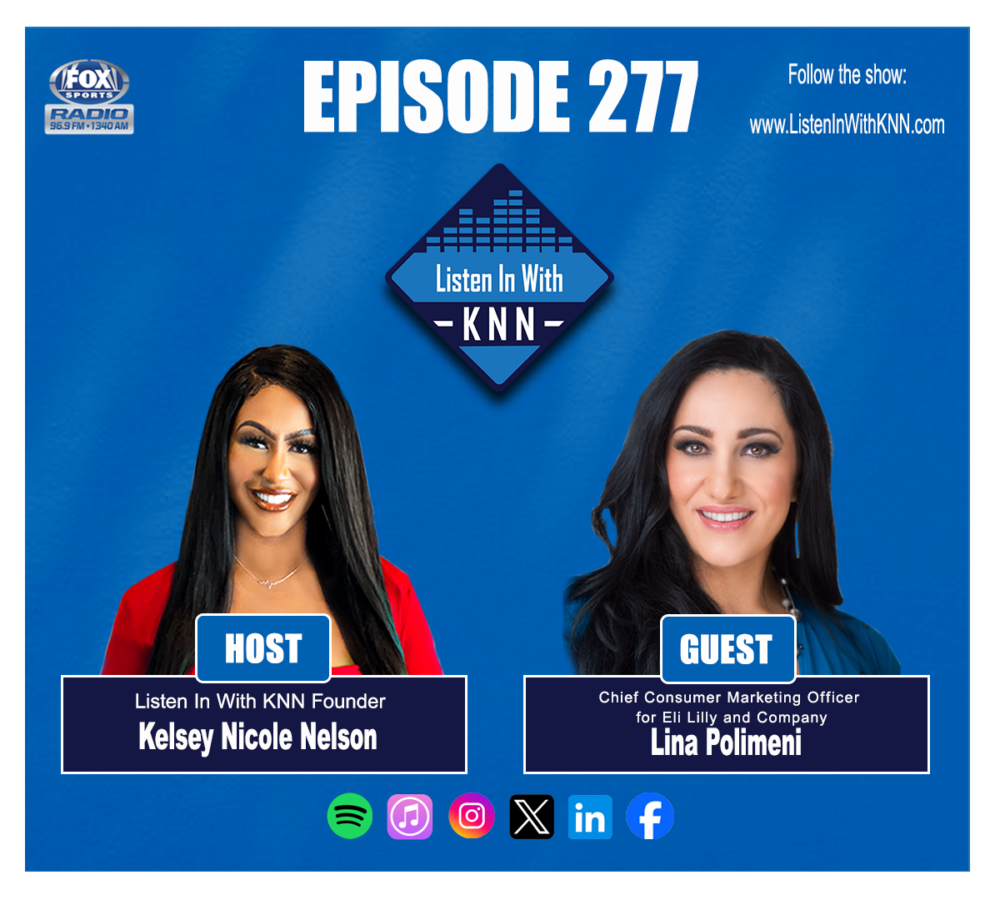
As sports continue to evolve into a major cultural platform, health messaging is evolving with it. Listen in with KNN Host, Founder and Executive Producer, Kelsey Nicole Nelson, sat down with Lina Polimeni, the Chief Consumer Marketing Officer at Eli Lilly and Company.
Polimeni brings more than two decades of experience at Lilly to the conversation, having spent 22 years with the company, she helped shape their consumer marketing strategy.
“I have a huge passion for marketing,” Polimeni said. “I always had this frustration of marketing, and especially health marketing, being separated from what was happening in culture.”
Lilly has been working with many athletes over the last few years to help promote health and preventive medicine. Launched ahead of the WNBA season, their newest campaign is in collaboration with one of the league’s most famous athletes, Caitlin Clark of the Indiana Fever.
As they broaden their presence in sports, they have partnered with athletes and teams across major leagues as part of a broader strategy to connect health messaging to cultural moments rather than clinical ones. Polimeni says that the shift was intentional,
“We’re showing up in big moments, but it’s not because of reach,” she said. “Reach without meaning is just a logo with a big budget. It’s just noise with a big budget.”
She spoke to the attention, emotion and passion that drives sports fans, something she utilizes when crafting marketing plans for the company.
“Sports have always been a place where people have their hearts and minds open,” Polimeni said. “Even when your team is losing, you’re still in a moment that you will remember, that you’re sharing what you love.”
Bringing the topic of health into such a passionate space moves Lilly towards their goal of making a shift to go from health conversations out of purely clinical settings and into everyday mainstream life.
“Health is usually discussed when symptoms show up or when bad things happen,” she said. “It should be a conversation in life.”
By embedding health messaging into cultural spaces, they aim to normalize those conversations earlier and more often — before they become reactive.
“Exercise doesn’t mean being on a podium as a top performing athlete,” Polimeni said. “Exercise means taking a look at where you are today and asking yourself, what can I do to move my body and keep my body healthy today?”
Rather than centering elite performance alone, she said the campaign focuses on accessibility and everyday movement. Meeting people where they are and showing them the importance and benefit of caring about health early on.
From a marketing perspective, Polimeni focuses on storytelling, moving away from traditional sponsorship models and toward more integrated narratives featuring the athletes themselves.
“When you stop looking at athletes as billboards, and you start looking at them as part of the storytelling and partners in how you tell the story, I think that’s where you unlock a very different type of connection with people.”
Lilly’s growing footprint in sports extends beyond the WNBA. Earlier this year, former NBA star Chris Paul also joined Listen in with KNN on behalf of Lilly during the men’s Final Four in Indianapolis, where he discussed athlete health, longevity, and the role wellness plays both on and off the court.
That philosophy is reflected in Lilly’s newest campaign ahead of the WNBA season, featuring Indiana Fever guard Caitlin Clark. The partnership continues the company’s investment in women’s sports, which Polimeni describes as a space where culture, community, and visibility intersect in meaningful ways.
As sports serve as an increasingly important point of connection, community, and influence, Polimeni sees an opportunity to meet audiences where they already are, turning moments of fandom into moments that also encourage healthier living.
